This, in a nutshell, is what I did to get a book with my name on it.
NOTE: This is just my personal way of making the words go. Other people have different ways to make their words go. In the world of words, there are no right answers. There’s just lots and lots of tea/coffee/tear stains.
1). The Idea
When I get an idea for a story, I open up a document, label it “Brainstorming,” and start making a bullet list of events that consist of the plot.
It has to be an idea with tangible weight. A stray bit of dialogue or something vague like Halloween, that doesn’t give me much to work off of. Halloween creatures living on the same street where it’s Autumn every day– now that’s something I can build from.
What kinds of creatures are they? What do they do? What do their houses look like? The best ideas are the ones that spark more.
2). First Draft
This is the easy part- and the most challenging. Easy, because there’s literally no bar. I just sat there and typed. But it’s a huge mental challenge.
When I was in first draft mode, I wanted that story out. I thought that by making it such a rough, far-away version from the concept in my head, I was only delaying the day where I’d hold it in my hands. Turns out, that’s what got it to take on physical form in the first place. So I quieted down, grabbed my laptop and some hot tea, and typed.
3). Dissecting the First Draft
After I finished draft one, I printed it all off and highlighted the scant amounts that were passable for the next phase. Dialogue, descriptions, setting- anything that didn’t look like it was up to par was scratched out and omitted.
I call the above pictures A Slow Descent Into Madness.
4). The Second Draft
On a fresh document, I rewrote the story altogether- and it make a difference. I was coming up with things I hadn’t even thought of previously. And it was surprising how much better the plot was than the first time around. But it was still rough.
5). Draft Three
My method was to start with the bigger, more obvious issues and work my way down. Any plot holes I found were noted, and my outline was constantly under revision. I cut out entire scenes and made mental notes on ways they could be fixed/replaced.
This is where I started cutting chapters in half to make the story flow better- but I didn’t bother writing in usable chapter titles. Instead, I improvised:
6). Drafts Four and Five
These were dedicated to correcting the smaller, less obvious plot holes. This was the point where the story finally started to look close to what would become the final version.
7). Drafts Seven Onward
With the story line looking how I wanted, I then moved on to sentence structure. That one song that looked terrible? Rewritten. Over-the-top descriptions and excessive prose? Gone.
8). Editing and Proofing
This is where I had outside help. Besides this useful tool, I had two people check for spelling issues and the overall story. Once it was in decent shape to be made public, I asked for some additional help.
9). Betas
My betas were in the age range that my novel was geared toward, along with a couple of teachers and parents (as it was middle grade). I gave them the full manuscript, along with seven basic questions like “Which characters were your favorite/least favorite and why?” and “Was there a part of the story that didn’t make sense?”
I gave my betas three months to read a 42,590 word story, and by the end they gave me back the review sheets.
10). Final Adjustments
After I read over the reviews, I let the comments sit for three days so that I could proceed with a clear head. I smoothed out any flaws, scanned over the MS twice to make sure everything was right, and that is how I got to the end of writing my first novel.
Next comes publishing- which is a different beast entirely.
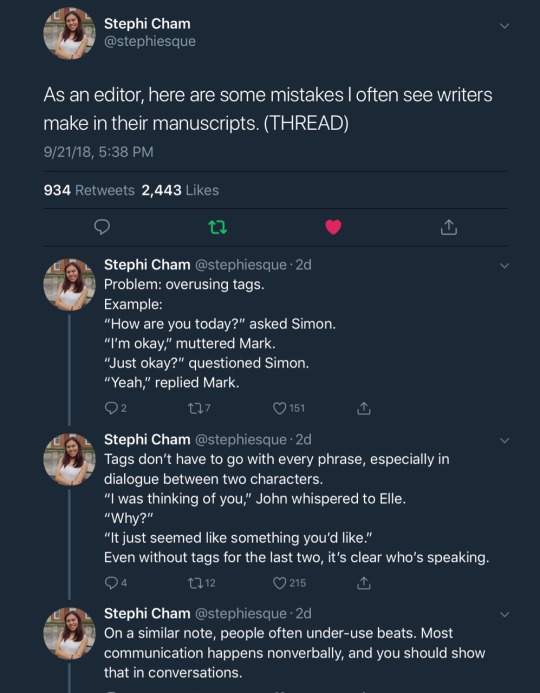
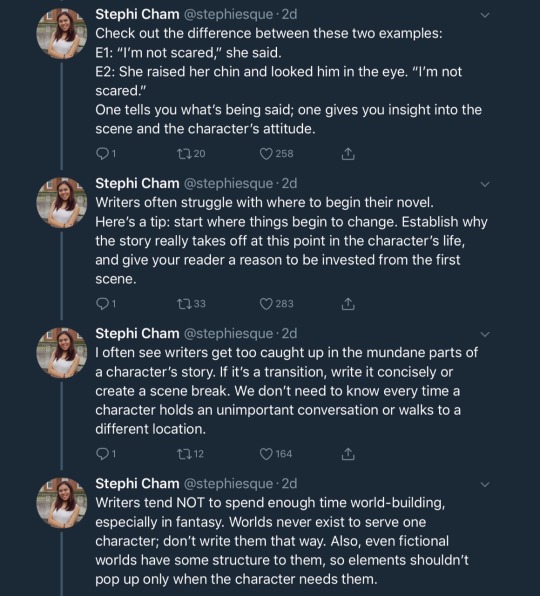
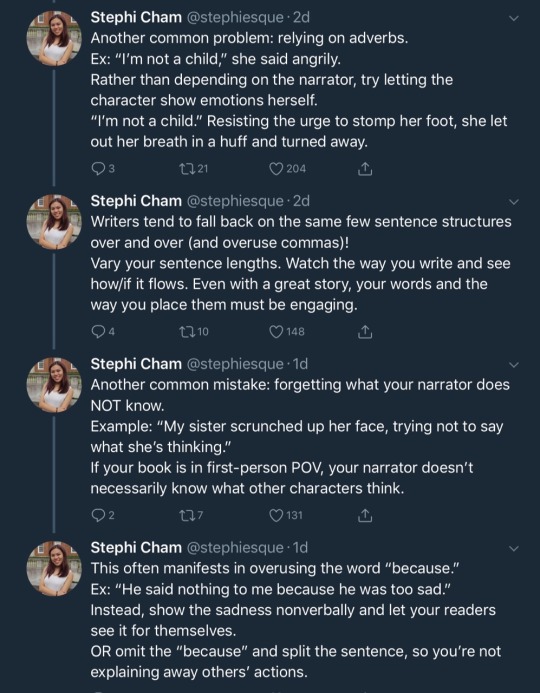
For future reference. Wow, what a comprehensive post.
This. This is good fiction writing advice. I really appreciate how it was formatted as “this is a common problem, here is a solution to try in your own work” and not “oh god, don’t do that!” without any extra help. And I extra appreciated the “don’t rely on adverbs” bit, because they do have their place but they aren’t the only way actions can be emphasized.
I got pretty fed up with looking for words to replace said because they weren’t sorted in a way I could easily use/find them for the right time. So I did some myself.
I’M DRUNK OR JUST BEING WEIRDLY EXPRESSIVE FOR A POINT/SARCASM Hooted Howled Yowled
I WONDER Pondered Voiced Wondered
OH, YEAH, WHOOPS Recalled Recited Remembered
SURPRISE BITCH Revealed
IT SEEMS FAKE BUT OKAY/HA ACTUALLY FUNNY BUT I DON’T WANT TO LAUGH OUT LOUD Scoffed Snickered Snorted
BITCHY Tattled Taunted Teased
Edit: People, I’m an English and creative writing double major in college; I understand that there’s nothing wrong with simply using “said.” This was just for fun, and it comes in handy when I need to add pizzazz.
I’m using this a lot. Maybe it can help you too, @irelandhoneybee @littledidtheyknow


 If I'm your savior, then you're mine.