man: has anyone ever told you you’re beautiful?
me: oh no sir, today is my first day out of doors and papà forbade mirrors in the house lest we fall victim to vanity
“Oh I love roses! I try growing them myself, but they never get very far.”
“Would you like to know the secret to healthy rose bushes,” I asked, knowing that she would not like the answer.
“Do tell!”
Grin. “Blood.”
The customer paused, waiting for me to say that I was kidding. But I wasn’t so it never came. She became nervous.
And before I could explain that blood meal is a common soil fixer and fertilizer, she put her hands up, spun around and said-
“Bye.”
You want to know the secrets to a beautiful garden? You better be prepared for some weird shit.
Well someone felt like being the ominous witch in the small, mysterious shop today.
.
…also, tomatoes like blood too.
My interest in plants extends beyond ‘oh look a pretty flower’ and straight into ‘plants are fucking metal.’
Evidently, you’re supposed to plant garlic in the same places as your roses because the garlic will repel a rose-specific aphid.
So what I’m saying is that between the romantic symbolism of the rose, the bloodmeal in the soil, and the fresh garlic all over the place-
You could really set yourself up for an encounter with some VERY pissed vampires.
Roses really love banana skins, too. Just… stick one in there before you plant a rose bush or spronkle around one that’s already in the ground. They’ll adore you.
Mmm… blood banana.
I made tiny ass Home Depot Petunias blossom like magic that they’re nearly overtaking the trellises.
How did I accomplish this?
Once a week I bury a small amount of leftover meat in the soil.
My morning glories loved the crap out of the charred chicken bones I gave them. They’re already an enthusiastic plant, but the blooms I had this year were extraordinary.
@thebibliosphere Well, if you ever get your allergies under some semblance of more control and want to get on Demon Rose’s good side, I guess
They also like fish too.
For anyone curious about why plants love blood and meat and bone and ash;
When looking at fertilizer, you’ll often see 3 numbers on the package somewhere, arranged like 10-10-10 or 30-5-10.
This is called the NPK ratio. It stands for N – Nitrogen, P – Phosphorus – K – Potassium.
The numbers are ‘Ratio of Nutrients’ – the percentage the product contains by volume, of each element.
NPK, and then some other elements classified as ‘micronutrients’ are what plants need to grow. High Nitrogen encourages fast plant growth, High Potassium encourages big blooms, and Phosphorus helps the plants breathe and store energy for later. Calcium and Magnesum are two of the larger micronutrient needs. Calcium is used to make sturdy cell walls, and Magnesium is is required for photosynthesis.
Blood and Bone and Ash all have fairly slow releases of their nutrients, so it’ll benefit the plant for a long time afterward. Meat is a bit faster release, but generally won’t burn the plants with too much nitrogen.
When bone is ground up, it’s 4-12-0 – Plus a bunch of Calcium.
When blood breaks down it offers a lot of Nitrogen. 12-0-0 –
Wood ash breaks down into primarily Potassium. 0-0-5
Meat aka Fish Emulsion (Aka several fish that have been put through a blender) is really high in nitrogen and is fast-release – 5-2-2
Dried Seaweed (like the kind you use for sushi) is loaded with other micro-nutrients that plants love.
Bat guano aka poop is 10-3-1 – Very good for rapid, lush growth.
Pretty much every greenhouse, especially if they’re leaning toward organic, will have blood and meat and bone and ash (and seaweed and animal poop lol) as a staple fertilizers.
Conclusion: Plants are goth af. A vampire who has excess blood, bodies, and bats just laying around will have a VERY lush and healthy garden.
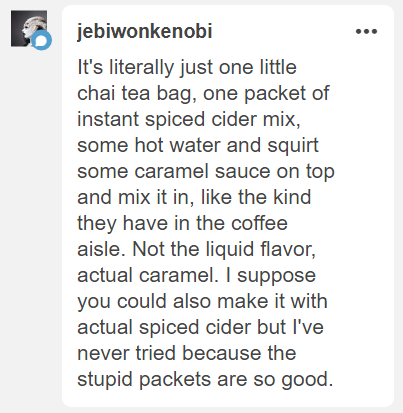
Once upon a time I worked in this little burger/coffee/ice cream shop and a lady came in one winter and asked if we had a caramel apple drink and we were like ‘well we have cider’ and she was like ‘no I don’t remember what it’s called but this place made a drink that was chai tea, apple cider, and caramel’ and Breezy offered to try and make something for her but she changed her mind and left so Breezy and I were like ‘alright let’s try this’ because we had chai tea, instant cider mix, a shit ton of caramel, instant hot water from the espresso and too much free time.
And let me tell you it was delightful. It tastes like watching the leaves changing color and dancing in the wind. It tastes like picking out pumpkins and gourds and fresh apples at the farm up north. It tastes like witches and freedom.
I make it every year now and this year I walked in the house on the morning of October first with all the ingredients and shouted ‘FALL DRINK’ and my roommates were like ‘????’ so I made them Fall Drink and now every time they get home from work they’re like ‘Fall Drink pls?????’
Anyway I remember literally nothing else about that woman but I’m very grateful to her.
for anyone wondering about proportions/etc here’s op’s answer from the repiles:
Everybody and their cousin has experienced the argument “is a tomato a fruit or a vegetable” at some point in their lives. It’s a fun bit of trivia, and let’s know-it-all’s speak condescendingly, or at least they did like 10 years ago. “Knowledge is knowing tomato is a fruit, wisdom is not putting it in a fruit salad”. Whatever.
Which brings up the point, that botany and culinary sciences are very different. Botany is the study of plants, culinary is cooking and how things taste. Botany is science, and it has rules (kind of), where cuisine is full of guidelines that are completely cultural.
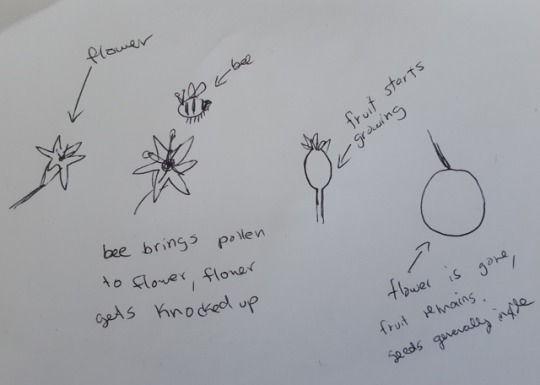
Tomatoes are a fruit. A fruit is how many plants have babies, and are made in the ovary of a flower. I have a diagram.
Armed with this knowledge we can know that tomatoes, cucumbers, squash, beans, peas and peppers are all fruit.
“Now”, I ask you, “what are lettuce, and cabbage, and spinach, and kale”?
“Vegetables”, you say, assuredly.
“Yes, but, what are they?”
“…vegetables”, you say, slower, and louder this time, not quite sure what I’m wanting from you.
No. They are leaves.
What are carrots, beets and radishes? Roots. What about celery and rhubarb? Stems. Potatoes? Tubers (food storage for the plant, and where new plant babies will grow from). Garlic and onions? Bulbs (also food storage). Mushrooms? They’re not even a plant, they’re a fungus, in the kingdom of fungi, which is somewhere between the plant and animal kingdoms.
“Vegetables” is just a word for plants that we eat, that doesn’t have enough sugar to be a fruit, and not enough flavour to be a herb or spice.
Botanically speaking, there is no such thing as a vegetable. They’re just different parts of a plant that happen to be edible.
There are other plants, normally considered weeds, that can be “eaten like a vegetable”. Dandelion, stinging nettle, dock, purslane, can all be cooked and eaten, making them vegetables, at least to the people to treat them as such. It’s all very cultural, and biased, and based on nothing but what people think it is. Therefore, they are not a real thing, it’s just a concept.
Into The Spider-Verse Peter Parker: I’m deeply depressed and gained a lot of weight from eating nothing but pizza for months
Me, slowly slipping off my bra: You poor thing, why don’t I make you feel better by [THIS POST WAS FLAGGED FOR EXPLICIT CONTENT, PLEASE PURCHASE A CUMBLR® SUBCRIPTION TO UNLOCK]




 If I'm your savior, then you're mine.